Open a cleaner’s store cupboard and you’ll find detergents, degreasers, sanitisers, disinfectants and descalers. Choosing the right product, mixing it to the right strength and handling it safely can prevent wasted money, damaged surfaces and avoidable safety risks. Here’s a practical guide to getting it right.
Start with the job, not the bottle
Most commercial cleaning chemicals fall into a few broad groups:
- Neutral detergents — for routine cleaning of suitable floors and surfaces.
- Alkaline degreasers — for grease and oily build-up, particularly in kitchens.
- Acidic cleaners — for mineral deposits and scale, where the surface is suitable.
- Glass and window cleaners — formulated to clean glass without streaks.
- Sanitisers and disinfectants — for controlling microorganisms, according to the product’s intended use.
- Floor care products — including strippers, sealers and polishes for appropriate floor types.
Start with what you need to remove and what the surface is made of. A stronger chemical is not automatically a better cleaner: it may cost more, leave residue or damage a surface. Check the product instructions before use.
Sanitiser vs disinfectant — not the same thing
Cleaning comes first. Detergent removes dirt, grease and food residue; sanitising a dirty surface may be ineffective. Food-contact surfaces such as benches, boards and utensils need to be clean and sanitary. Use a sanitiser suitable for food-contact surfaces, at the specified dilution and contact time. Check the label to see whether it needs rinsing afterward. (Food Standards Australia New Zealand)
Disinfectants are used where their specified germ-killing action is needed. Choose one suitable for the surface and setting, then follow its instructions for pre-cleaning, dilution and the time it must remain on the surface. In Australia, how a disinfectant is regulated depends partly on the claims made for it; products making specific claims must be listed on the Australian Register of Therapeutic Goods. (Therapeutic Goods Administration (TGA))
Concentrate vs ready-to-use — where the money is
Ready-to-use (RTU) products are convenient: staff can pick up the bottle and use it as directed. Concentrates take less space to store and can cost less per prepared litre, particularly at sites that use a lot of product.
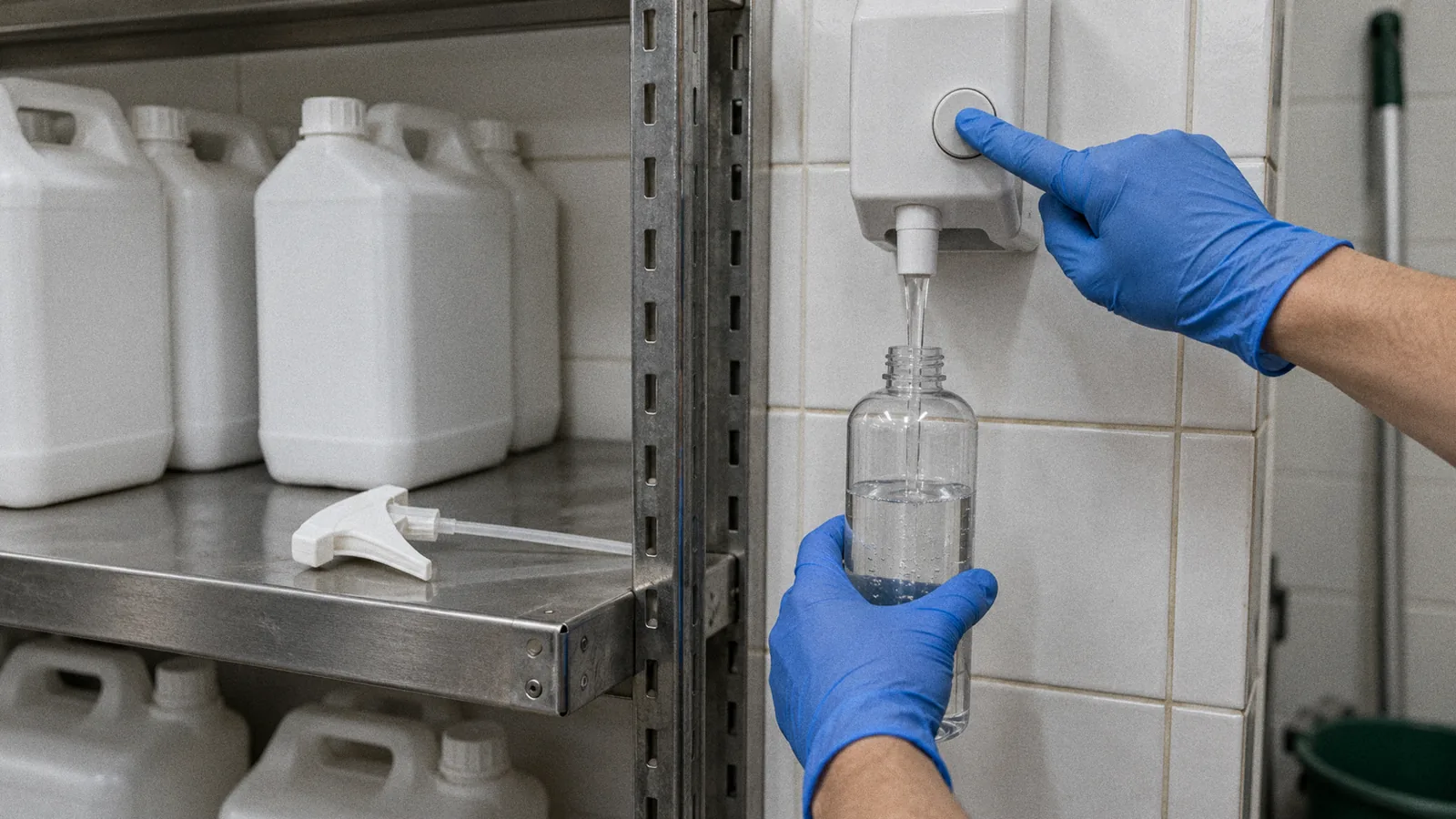
The saving depends on getting the dilution right. Too little chemical can mean poor results and re-cleaning. Too much wastes product and may leave residue, damage surfaces or increase exposure risks. Measure according to the manufacturer’s instructions. A dosing system or dispenser can help keep the mix consistent across shifts; compare the full cost, including equipment and servicing, when deciding whether it suits your site.
Safety Data Sheets (SDS) — not optional
In Victoria, employers using or storing hazardous substances or dangerous goods must obtain a current Safety Data Sheet (SDS) for each applicable product and make it accessible to workers who may be exposed. WorkSafe also requires a register of hazardous substances at the workplace. (WorkSafe Victoria)
An SDS sets out the product’s hazards, first aid, protective equipment, safe handling and storage, spill response and other safety information. Keep it somewhere workers can access when they need it, including when the person who manages the store cupboard is away. Manufacturers and importers must review SDS at least every five years and revise them when necessary; check that the copy you hold is current. (WorkSafe Victoria)
Australia moved to GHS 7 for classifying and communicating hazards on newly manufactured or imported hazardous chemicals from 1 January 2023. It is the system behind the hazard information on labels and SDS, including pictograms, signal words and hazard statements. (Safe Work Australia)
Labelling — including what you decant
Keep chemicals in their correctly labelled original containers wherever practical. If staff regularly dilute a product into spray bottles, label those bottles clearly so anyone picking one up can identify the contents and hazards. Use the supplier’s approved secondary-container label or follow the product SDS and your site’s labelling procedure.
An unmarked bottle can be mistaken for another cleaner — or even for water. WorkSafe has documented serious injuries involving chemicals in unmarked containers. Never put cleaning chemicals in food or drink containers, even if you label them. Limited immediate-use exceptions to decanted-container labelling exist, but a labelled bottle is the sensible approach for products kept for later use. (WorkSafe Victoria)
Handle safely — PPE and the golden rule
Follow the label and SDS for gloves, eye protection, ventilation and safe storage. Keep incompatible products separate as directed.
Never mix different cleaning chemicals unless the manufacturer specifically instructs you to. Bleach mixed with an acid can release toxic chlorine gas; mixing it with ammonia can produce harmful fumes. Use one product as directed, and follow the manufacturer’s instructions before switching products on the same surface. (WorkSafe Victoria)
How to choose — a quick checklist
- Match the product to the job, soil and surface.
- For food-contact surfaces, clean first, then use a suitable sanitiser as directed.
- Compare RTU and concentrate costs at the correct in-use dilution.
- Obtain current SDS for applicable hazardous substances and dangerous goods, and make them accessible.
- Check the label and SDS for dilution, contact time, rinsing, PPE and incompatible chemicals.
- Label spray bottles and standardise the products staff use across the site.
Byars supplies commercial cleaning chemicals and can help you choose products, set up dilution equipment and obtain the relevant SDS. If you’re unsure which product suits a job or how it should be mixed, ask us or your rep before using it.
Frequently asked questions
Do I legally need an SDS for cleaning chemicals?
In Victoria, employers must obtain current SDS for the hazardous substances and dangerous goods they use or store, and make them accessible to relevant workers. You should also maintain the required hazardous-substances register. (WorkSafe Victoria)
What’s the difference between a sanitiser and a disinfectant?
A food-contact sanitiser is used to reduce microorganisms on clean food-contact surfaces to a sanitary level. A disinfectant is chosen for the germ-killing action claimed on its label. In either case, check that the product suits the surface and follow its dilution, contact-time and rinsing instructions. (Food Standards Australia New Zealand)
Are concentrated chemicals cheaper than ready-to-use?
They often cost less per prepared litre, particularly with regular use. Calculate the cost at the specified dilution and include any dispensing equipment or servicing before comparing them with RTU products.
Do I need to label a chemical I’ve decanted into a spray bottle?
A spray bottle kept for later use should be clearly and appropriately labelled so workers can identify its contents and hazards. WorkSafe describes limited exceptions for chemicals transferred for immediate use. (WorkSafe Victoria)
What is GHS 7?
GHS 7 is the seventh revised edition of the international system used to classify and communicate chemical hazards. It informs the hazard information on labels and SDS for hazardous chemicals. (WorkSafe Victoria)
Sources: WorkSafe Victoria’s SDS guidance, WorkSafe Victoria’s chemical labelling guidance, Food Standards Australia New Zealand’s cleaning and sanitising guidance, and TGA disinfectant guidance. Always follow the product label and SDS. General information, checked September 2026.
CTA: Browse cleaning chemicals · Search the SDS library · Request a quote · Call (03) 5229 9998